The Octahedron & The Cube
The Octahedron and the Cube are duals of one another. The object formed by joining the centres of the faces of a cube is an octahedron, and vice versa.
Rule: Duals share the same point groups.
Octahedron ($O_h$)
Order = 48Symmetry Operations:
Click below to visualize the symmetry elements in the 3D viewer:
$O_h = \{E, 8C_3, 6C_2, 6C_4, 3C_2, i, 6S_4, 8S_6, 3\sigma_h, 6\sigma_d\}$
Cube ($O_h$)
Order = 48Symmetry Operations:
Notice how the locations of axes swap compared to the Octahedron!
Exactly the same elements as $O_h$
Pure Rotational Group: $O$
If we remove all operations involving reflection or inversion from $O_h$ (i.e., $i, S_4, S_6, \sigma_h, \sigma_d$), we are left with the pure rotational subgroup $O$.
$O = \{E, 8C_3, 6C_2, 6C_4, 3C_2\}$
Order = 24
Icosahedron & Dodecahedron ($I_h$)
Another pair of Platonic duals sharing the highest discrete point group symmetry.
Icosahedron
Order = 120Symmetry Axes:
Visualize major rotational axes:
Dodecahedron
Order = 120Symmetry Axes:
Notice the dual relationship: Face and vertex axes swap!
Pure Rotational Subgroup ($I$)
Determining Point Groups
A systematic flowchart approach to identify the point group of any molecule or object.
point group
point group
Interactive Flowchart: Real World Cacti
Follow the flowchart steps interactively to identify the point group for these two star cacti. Click the correct answers to reveal the path.
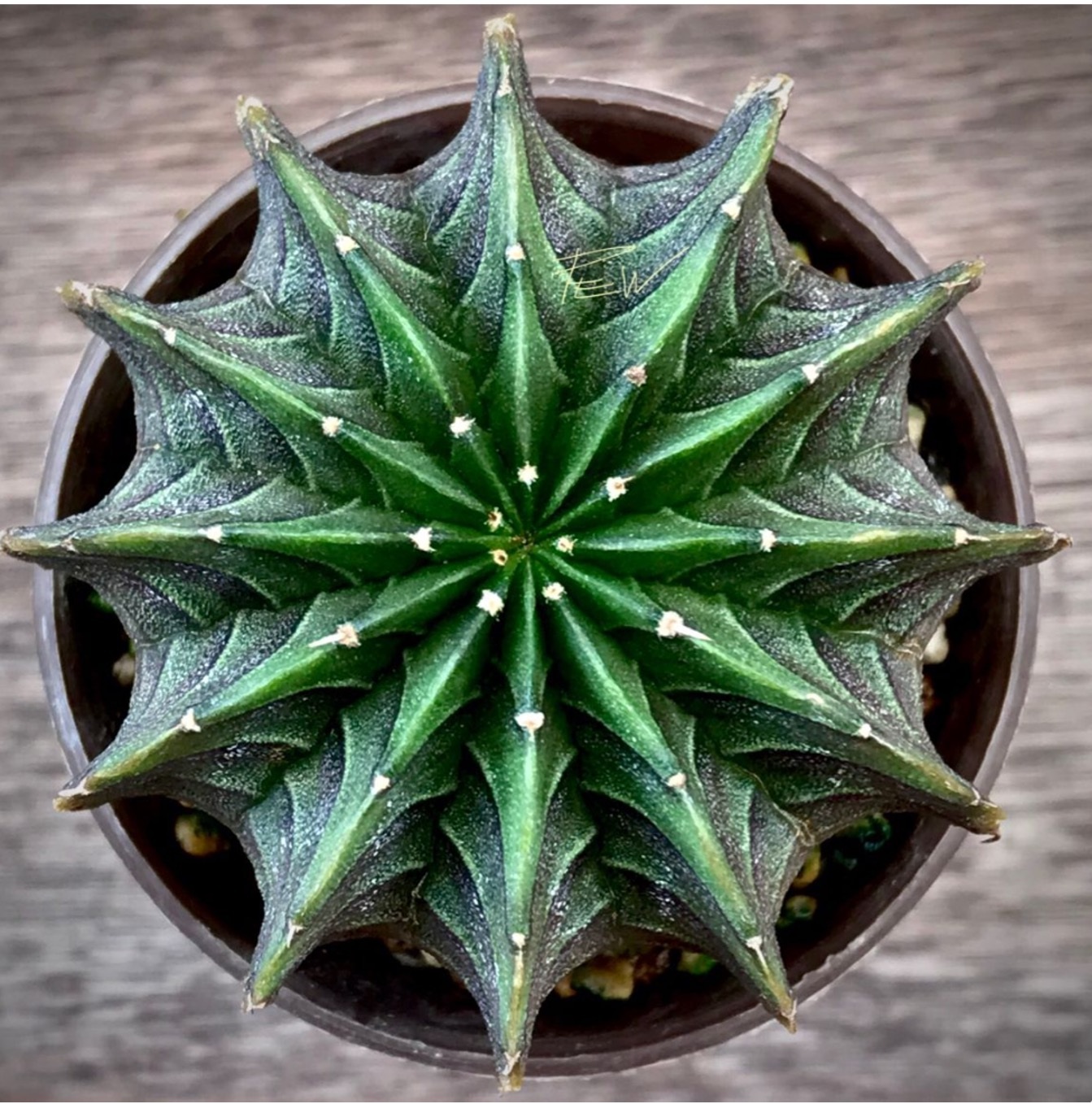
Monocolor Star Cactus
Step 1: Is a $C_n$ axis present?
Incorrect. Hint: Look at the top-down symmetry.
Final Point Group
$C_{12v}$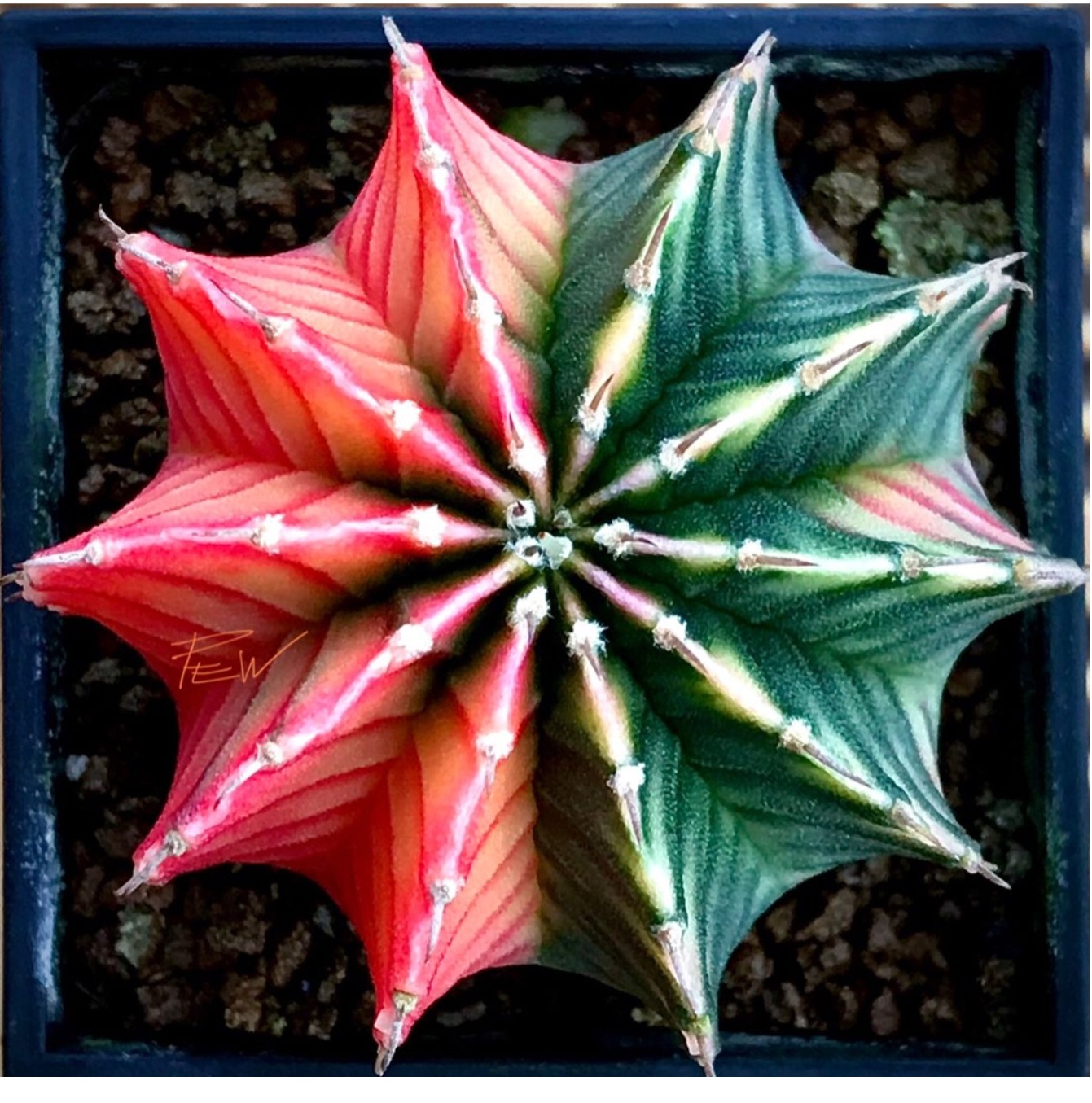
Bicolor Star Cactus
Step 1: Is a $C_n$ axis present?
Incorrect. Hint: Does the color alternating pattern allow full rotation?
Final Point Group
$C_s$Stereographic Projections
Definition & Construction
A 2-D representation of a 3-D object located at the centre of a sphere. This projection preserves angular relationships between faces or vectors, making it invaluable in crystallography.
How to Construct:
- Consider a point $P$ on the surface of the sphere.
- If $P$ is in the Northern Hemisphere, draw a line to the South Pole. The intersection with the equatorial plane is the projection (marked as a • filled circle).
- If $Q$ is in the Southern Hemisphere, draw a line to the North Pole. The intersection is marked as a larger (○ open circle).
All 32 Crystallographic Point Groups
Stereographic projections showing symmetry elements (cyan) and symmetrically equivalent points (white). Solid dots are in the Northern Hemisphere, open circles in the Southern Hemisphere.
Interactive Projection Builder
Select a point group and generate its stereographic projection step-by-step to see how symmetry operations propagate a general point.
Select a group
Example: $C_{3h}$ Point Group
Fill the multiplication table by clicking on the ? cells. The stereogram will demonstrate $Op_2 \circ Op_1$ (applying Op 1 from the row first, then Op 2 from the column).
Stereographic Visualization
Click a cell in the table to see how the two symmetry operations combine.
| Op 1 (Row) \ Op 2 (Col) | $E$ | $C_3$ | $C_3^2$ | $\sigma_h$ | $S_3$ | $S_3^5$ |
|---|---|---|---|---|---|---|
| $E$ | ||||||
| $C_3$ | ||||||
| $C_3^2$ | ||||||
| $\sigma_h$ | ||||||
| $S_3$ | ||||||
| $S_3^5$ |
Translations & Crystallography
In crystallography, there is one more essential symmetry operation: Translation. Let's see how it forms lattices.
Lattice
An infinite array of points in space that has the exact same environment at every point.
Motif / Basis
The repeating physical element (atoms, molecules, ions) attached to each lattice point.
Primitive Unit Cell
The smallest possible space which repeats itself and contains exactly one lattice point in it.
Generating Lattices via Translation
All lattice points can be generated simply by translation along basis vectors ($T_1, T_2, T_3$), without needing any other symmetry operation.
Vector $\mathbf{T} = n_1\mathbf{T_1} + n_2\mathbf{T_2} + n_3\mathbf{T_3}$
1D Lattice
Translation along one dimension only.
2D Lattice
Translation along two distinct dimensions.
3D Lattice
Requires $T_1$, $T_2$, and $T_3$ (out of plane) to form full crystal structures.
Beyond the Classroom: Real-World Applications
The study of crystal symmetry and point groups extends far beyond mathematical theory. These principles are actively used across various scientific and engineering disciplines.
Metallurgy
Pole figures for texture analysis in rolled sheets.
Nanotech & Virology
Icosahedral symmetry in viral capsids and Buckyballs.
Pharmacology
Chirality and point groups in drug design and efficacy.
Semiconductors
Lattice translations for doping and defect engineering.
Did It Sink In? - 6
Test your mastery of high-symmetry point groups, dual polyhedra relationships, stereographic projections, and the identification flowchart.